.png)
MANUAL OR AUTOMATIC LABELING: WHICH SOLUTION SHOULD YOU CHOOSE?
The choice between manual and automatic labeling mainly depends on production volume, the consistency of your production pace, and the level of precision required. For small, irregular batches, manual labeling is often sufficient. As soon as volumes increase or a stable pace is needed, automatic labeling becomes necessary to ensure quality and productivity.
This choice has a direct impact on costs, labor requirements, and the image of the finished product.
The limits of manual labeling
Manual labeling involves applying labels by hand, sometimes with the help of a simple applicator.
This method has several drawbacks:
Limited throughput, dependent on the operator's speed
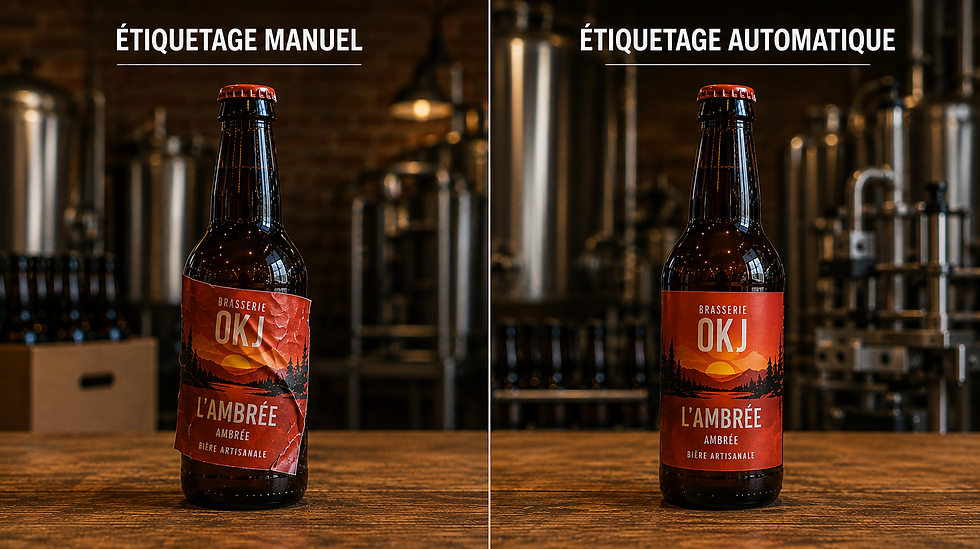
A high risk of irregularities: crooked, off-center, or peeling labels
Physical strain on staff from repetitive tasks
Difficulty absorbing production peaks
It remains suitable for very small businesses, limited batches, or occasional production runs.
The advantages of automatic labeling
An automatic labeling machine applies labels consistently, with a level of positioning accuracy far superior to manual application.
The main benefits are:
A stable pace, even for long production runs
Consistent label placement from product to product
A reduction in labor time devoted to this task
A stronger brand image thanks to a professional, uniform finish
Automation also frees up staff, who can be reassigned to higher value-added tasks.
When should you switch to automatic labeling?
Switching to automation is generally justified when production volumes increase steadily, or when defects from manual application start affecting the quality perceived by customers.
Other warning signs to watch for: labeling time becoming a bottleneck on the line, difficulty recruiting or retaining staff for this role, or the need to handle multiple container formats with precision.
There is no universal threshold: every business has its own tipping point, depending on its pace and constraints.
An investment worth putting into perspective
Automatic labeling requires a higher upfront investment than a manual solution. However, it should be evaluated over the long term: time savings, reduced waste from application errors, less physical strain, and improved consistency of the finished product.
OKJ Concept is a French manufacturer of custom-built industrial labeling machines, specializing in adapting each machine to the customer's production line rather than selling standardized equipment. This approach allows it to serve both small operations and high-pace production lines, with full support: design, manufacturing, installation, and training.

Conclusion
The choice between manual and automatic labeling depends above all on production volume and the level of consistency required in label application. Automation becomes relevant as soon as pace, quality, or workload start to hold back production.
OKJ Concept supports French and international companies through this transition, designing labeling machines for a range of sectors: breweries, cosmetics, food industry, spirits, and general industry. Each machine is designed around the customer's actual product and pace, with average manufacturing lead times of 3 to 6 months and training provided at commissioning.
Need help assessing your situation?
Every business has its own production constraints. At OKJ Concept, we help you determine whether automating your labeling process makes sense, and define the solution best suited to your volumes.